It's Greek to me!
It's Greek to me!, 1991
It's Greek to me! Is one of the 123 artworks that include oil on canvas, on paper, paper reliefs, papier collés and sculptures, viz, the Times Series, created and exhibited in the artist's 10th solo exhibition in 1991. All works are inspired by and reflect the notion of time.
It is painted based on the original meaning of the phrase. The artist, who is also a mathematician, grew up with Greek alphabets, has traveled to a number of cities in Greece. The essence of Greek alphabets (top right corner, reading from right to left1) in mathematics is brevity, hence the minimalist approach to this painting. In the center of the painting, one sees a crawling worm, eating ("chewing") up time, thus displaying the
d
e
c
a
y
i
n
g
factor as the V-shape line to the left of the worm. The θ2) on the left bottom corner denotes the Simple Harmonic Motion (commonly known as SHM)3) while the worm lazes along the crystal clear
Mediterranean
coast, watching the sun (as denoted by the thick orange blob) rises and sets "the whim of golden opportunities".
Ironically, in mathematics, when one doesn't understand the working of a mathematical function or equation, one reads a "line (as in mathematical text & symbols)" at
Pun intended, this is one of those paintings that contains layers of meaning, it is also where the artist's sense of humor comes through, as always!
Origin of the phrase:
It is Greek (Graecum, L.) means: "it cannot be read". When something is unintelligible: "It's Greek to me!" The phrase originate from a Medieval Latin proverb "Graecum est; non potest legi" (It is Greek; it cannot be read)
In 16th Century:
ii William Shakespeare, in Julius Caesar (Act I Scene II): "Those that understood him smiled at one another and shook their heads; but for mine own part, it was Greek to me" c1600
iii Elizabethan playwright, Thomas Dekker (c1570-1632): "I'll be sworn he knows not so much as one character of the tongue. Why, then it's Greek to him".c1599
Both the Latin and the English meant then just what the phrase does now, to refer to something that is unintelligible. The Spanish version of this proverb is "hablar en griego", which is commonly said to be the origin of the word gringo, so someone is referred to as a gringo is literally accused of speaking Greek and hence being unintelligible.
Notes:
1) In Chinese language, one reads from right to left.
Book ref: "Works from Time Series" ISBN:978-981-002-704-9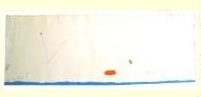
Oil on Paper
28 x 76 cm
Time Series
 Oil on Paper
  Time Series
 c r a w l i n g s p e e d
! This is when one says, "It's Greek to me!"
In Greece, when one something cannot be read, or unintelligible, they say "It is Chinese to me!"
2) In mathematics, this is to be read as theta double dot
3) Simple Harmonic Motion can serve as a mathematical model of a variety of motions, such as the oscillation of a spring. Other phenomena can be approximated by simple harmonic motion, including the motion of a simple pendulum and molecular vibration.
digital art museum, first virtual museum in the world since 1994