PAPER WORKSHOP
INTRODUCTION - THE ARTIST AND PAPER
Though plastic money are being used widely, it will take sometime before the "notes" are completely vanished, maybe even never. Certificates and the like still reside on paper and play an important part in our lives. As we consciously try to preserve our rain forests, not only paper becomes rare, hand-made and artist hand-made paper may become extinct eventually.
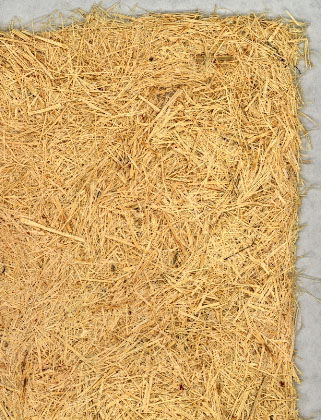
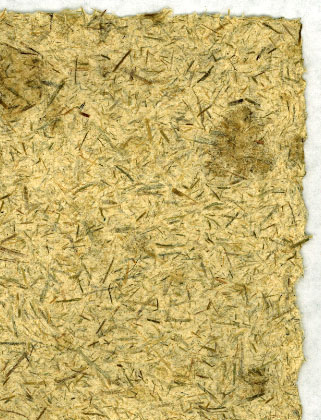 Artist Lin Hsin Hsin who is also an Information Technologist and Poet
makes and writes about paper. Since 1986, not only she has taken a
liking in creating artworks on paper, she studied paper making from
Mr H Kubo, from Omagawaguchi, a village in Saitama Prefecture in Japan.
Hsin Hsin is the first in the world to make acid-free Papaya Paper and Umbrella Paper (shown
respectively).
Artist Lin Hsin Hsin who is also an Information Technologist and Poet
makes and writes about paper. Since 1986, not only she has taken a
liking in creating artworks on paper, she studied paper making from
Mr H Kubo, from Omagawaguchi, a village in Saitama Prefecture in Japan.
Hsin Hsin is the first in the world to make acid-free Papaya Paper and Umbrella Paper (shown
respectively).
Umbrella plant, used in making umbrella paper
She is a member of the International hand Papermakers and Paper Artists Association based in Switzerland since 1990
We hope you have visited our "Oil on Paper" and "Paperworks" galleries.
PAPER -- A BRIEF HISTORY
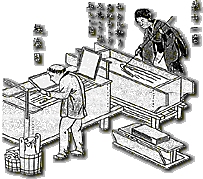 In the Year 105 A.D. Chinese Cai Lun 蔡伦invented paper from the
macerated fibers of bark, cloth and hemp.
In the Year 105 A.D. Chinese Cai Lun 蔡伦invented paper from the
macerated fibers of bark, cloth and hemp.
The Chinese managed to keep the well-guarded secrets for about 500 years. Around 610 A.D., the information was first leaked out first to Korea then to Japan.
In 751 A.D. Chinese attacked Arabs in Samarkand. The invasion was
repelled by the Arab governor, two captured Chinese happened to be
paper-makers, hence the art of paper making traveled to Egypt. Those
days paper was made from Papyrus in Egypt.

Since then, paper spread throughout the Arab world, then travel to Spain in the 12th Century during the Moorish occupation. During this period the Spainards introduced cotton as paper fiber.
Later in 1276, paper was introduced in Fabriano, Italy and Germany in 1390. The paper making tradition crossed the German border to France by a crusader while he was imprisoned by the Arabs.
The production of the Guttenberg Bible in 1456 ushered in the beginning of book-printing.
The process of paper-making was first mechanized in 19th-century, hence the gradual disapperance of hand-made paper. It is not until the late 60's there was a sudden revical of paper-making interests.
In ASEAN countries, where the artist is based, making paper by hand is relatively active in Thailand, Philippines and Indonesia.
Todate, there are some 1,000 varieties of paper in the world
WASHI
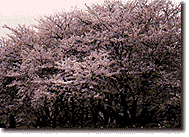
Sakura in full blossom, Japan
Paper has always been treated with reverence in Japan. The Japanese word for paper kami, is hononomous with native gods. Two important paper museums can still be found in Tokyo and Kyoto. In the Tokyo museum which the artist has visited, she saw a replica of the original Chinese paper made by the inven Amongst the exhibits she was most impressed by the paper bench that could carry the weight of 3 seated adults.
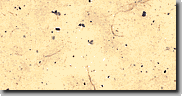
Washi was invented in the early 20th century.
Japanese use paper extensively.
Besides making the traditional calligraphy, painting and woodblock printing, paper are used for making shoji (sliding door) and sliding screen. The Japanese Yen, made from Gampi is one of the strongest paper. The roof of the leading contemporary western art collection at Hara Museum ARC at Shibukawa is also made of paper! Indeed, a unique creation of the architect Arata Isozaki.
Some Tools & names on Washi making
 su (screen)
 The removable, flexible surface of a Japanese papermaking mould. It is usually made of very thin bamboo strips which are woven together with specially prepared silk thread.
 keta (frame)
The hinged wooden frame that holds the removable screen or su in a Japanese
paper mould. With the screen in place, the mould is referred to as sugeta
 kozo
kozo
General name for a variety of mulberry trees used in Japanese paper making.
The fiber is the longest (avg 10 mm) amongst Japanese fibers. It can be
cultivated, and it accounts for 90% of the bast fiber used in washi making
today.
 mi mi (deckle edge)
the uneven feathery edges of a sheet of hand made paper formed naturally
during the paper making process by a small amount of pulp washing between the
mould and the deckle. It can be minimized or maximized depending on taste.
Aquarelle Arches Papier
All oil on paper paintings are painted on Aquarelle Arches Paper made in
France. It is 100% cotton, mould made, gelatine tub-sized, air dried with 4
deckle edges and watermarked. The paper weighs 300 grams per square meter
with 56 x 76 cm sheet size.
watermark
the more translucent area(s) of a sheet of paper are visible when view
through light. It is resulted by the impressions left in the pulp by the fine
wire or metal relief designs which are sewn to the surface of the mould. When
a sheet is formed on the mould, the pulp settles in a thinner layer over the
wired design. Today, watermarks are primarily used as logos or trademarks to
identify the paper, artist, papermaker or papermill.
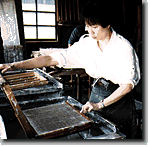
Lin in Japan making paper
LAMA PAPER
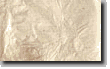
Lama paper, one of the strongest paper in the world is the handmade
paper from Nepal. This ancient art of making paper by hand is first
brought to Nepal by the Chinese. It was first picked up by Gurungs and
Magars in western Nepal, and by Raisand Limbu in the eastern region.
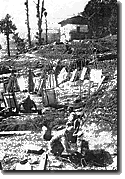
Paper making at Papa village, Nepal
It is made from the bark of the Lokta shrubs or Daphne tree. The collective name Lokta represents various plants like Baruwa, Sikra, Susu, Kagate paat and Locati that grow in the northern Himalayas reigion at an high altitude of some 17,000m above sea level.
This paper, even the tools are handmade by the Nepalese from the village according to the tradition date back to the 11th Century. After the bark is peeled off from the tree, they are soaked in mountain stream water for twenty four hours. Afterwhich, the rough parts are sorted out, the drained bark is then boiled on wood fire for one and the half hours.
After draining off the water, the Lokta is beaten on a flat stone, with a solid wooden hammer until it turn into a soft pulp. The pulp is then mixed with water again placed in a wooden barrel cut out from the tree trunk. Pour the pulp into a mold, stir it evenly. After sun-dried, you get your paper!
Because of the extreme long fiber of the Daphne tree and the way in which the paper was made, the uncrushed fibers make this textured fragile-looking paper very tough and elastic.
According to a report by UNESCO, Lama paper is acid- insect- and rodent-free. It lasts between two to three hundred years.